

 English
 Español
Up to 65% of growers misidentify leaf discoloration, leading to corrective actions that actually accelerate plant...
Suche im Blog
Blog-Kategorien
Beliebte Beiträge

Wie verwendet man AutoPot mit der Green House Feeding BioLine!
AutoPot-System mit Green House Feeding BioLine
Read more
Was bedeutet das VPD ?
VPD steuert, wie viel Wasser die Pflanze verliert – und damit Kühlung, Nährstoffaufnahme, das Verhalten der Stomata...
Read more
Wie verwendet man AutoPot mit der Greenhouse-Feeding-Mineral-Linie?
Wie verwendet man AutoPot mit der Greenhouse-Feeding-Mineral-Linie?
Read more
Gekennzeichnet Beiträge
What Is Photosynthesis? And why is the most important thing on earth?
What Is Photosynthesis? And why is the most important thing on earth?
Read more

Irrigation method with lightmix (peat based substrate) + GHF Bioline (peat based substrate)
How to optimize your irrigation when using peat based substrate and organic dry amendment like our Bioline ?
Read more

Was bedeutet das VPD ?
VPD steuert, wie viel Wasser die Pflanze verliert – und damit Kühlung, Nährstoffaufnahme, das Verhalten der Stomata...
Read more
Belüfteter Komposttee mit zusätzlichen Mineralien
Belüfteter Komposttee – Extra Mineralien: Calcium & Spurenelemente
Read more
Nutrient Film Technique (NFT): The Expert Guide to High-Performance Hydroponics
Most growers believe that high-performance hydroponics requires a complex network of sensors and software; they're wrong. True mastery lies in the precise execution of the fundamentals. You already understand that the nutrient film technique offers some of the most efficient bio-availability in the industry, yet the fear of a 15 minute pump failure or persistent salt buildup often keeps you tethered to less efficient methods. It's frustrating to manage shallow channels when root temperatures fluctuate or mineral deposits threaten your harvest.
We've refined the science to eliminate these stressors. By mastering the mechanics of this system, you can achieve 25% faster growth cycles and reduce water waste by up to 90% compared to conventional irrigation. This guide provides the professional framework you need to manage nutrient chemistry and system automation with quiet confidence. We'll examine everything from optimal channel slopes to chelated micro-element solubility, ensuring your operation achieves maximum yield with minimal complexity.
Key Takeaways
- Understand why a precise 1-3mm water depth is the professional standard for the nutrient film technique to ensure optimal root oxygenation.
- Calculate the perfect 1:30 slope and flow rate to maintain a consistent, high-performance recirculating environment.
- Master nutrient chemistry and EC management to ensure maximum mineral bio-availability without the risk of system clogs.
- Learn to integrate specialized powder feeding schedules that deliver zero-residue results for maximum yield with minimal complexity.
Understanding the Nutrient Film Technique Mechanism
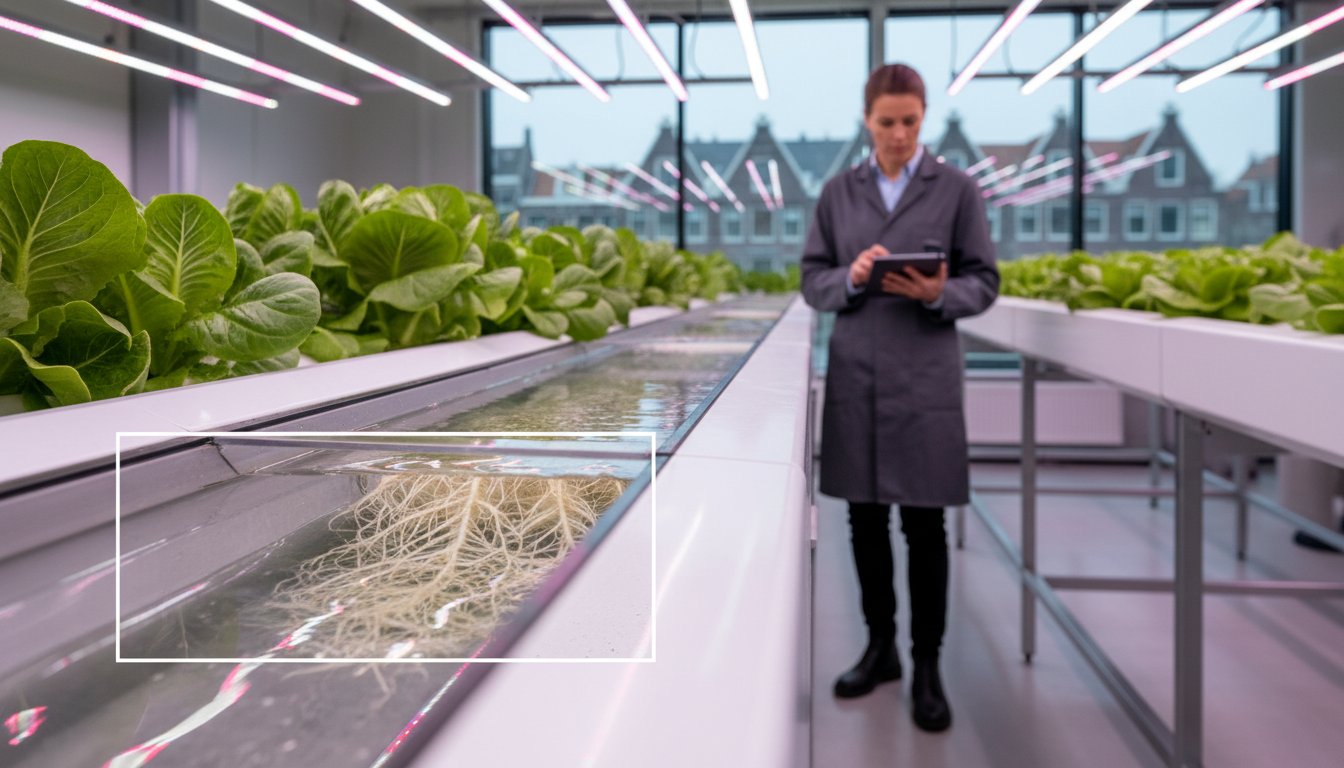
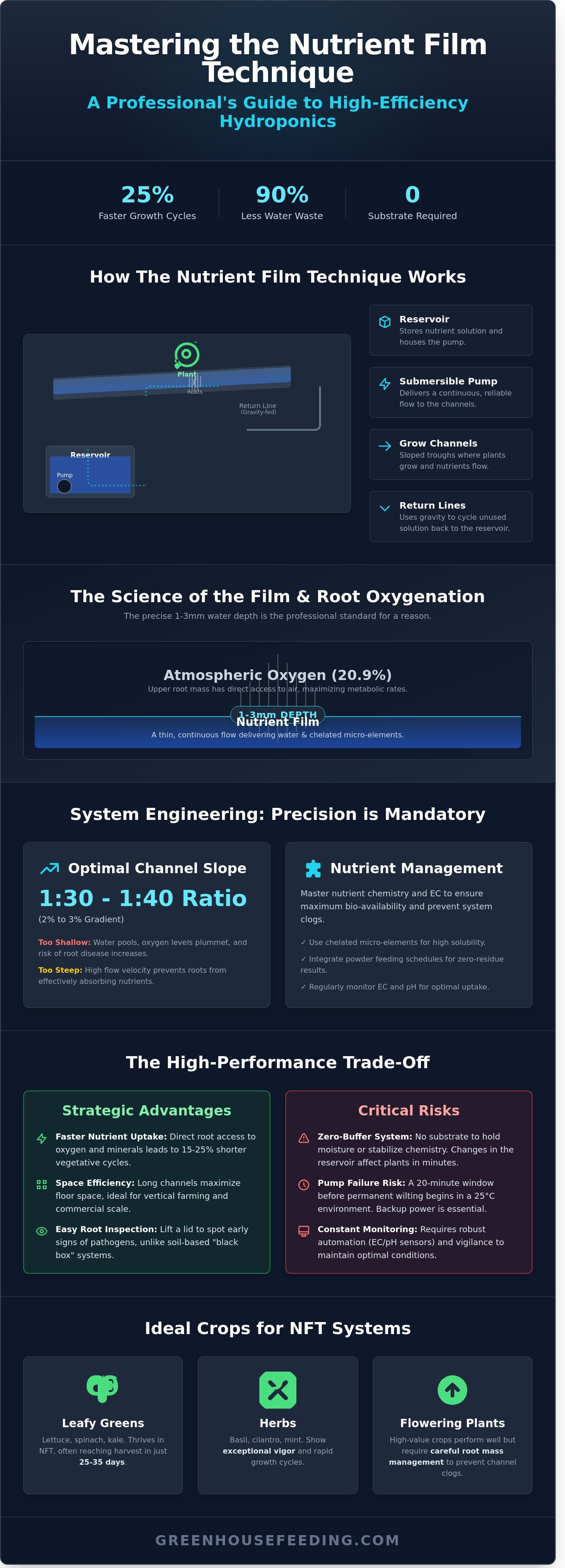
The nutrient film technique is a high-efficiency, active recirculating system designed for maximum nutrient uptake. It eliminates the need for heavy substrates, relying instead on a thin, continuous stream of water. This delivery method ensures that plants receive a precise balance of hydration and nutrition without the risks associated with over-saturation. Efficiency is the core of this design. By moving a small volume of water constantly, you maintain high solubility and prevent the stagnation that often leads to pathogen growth.
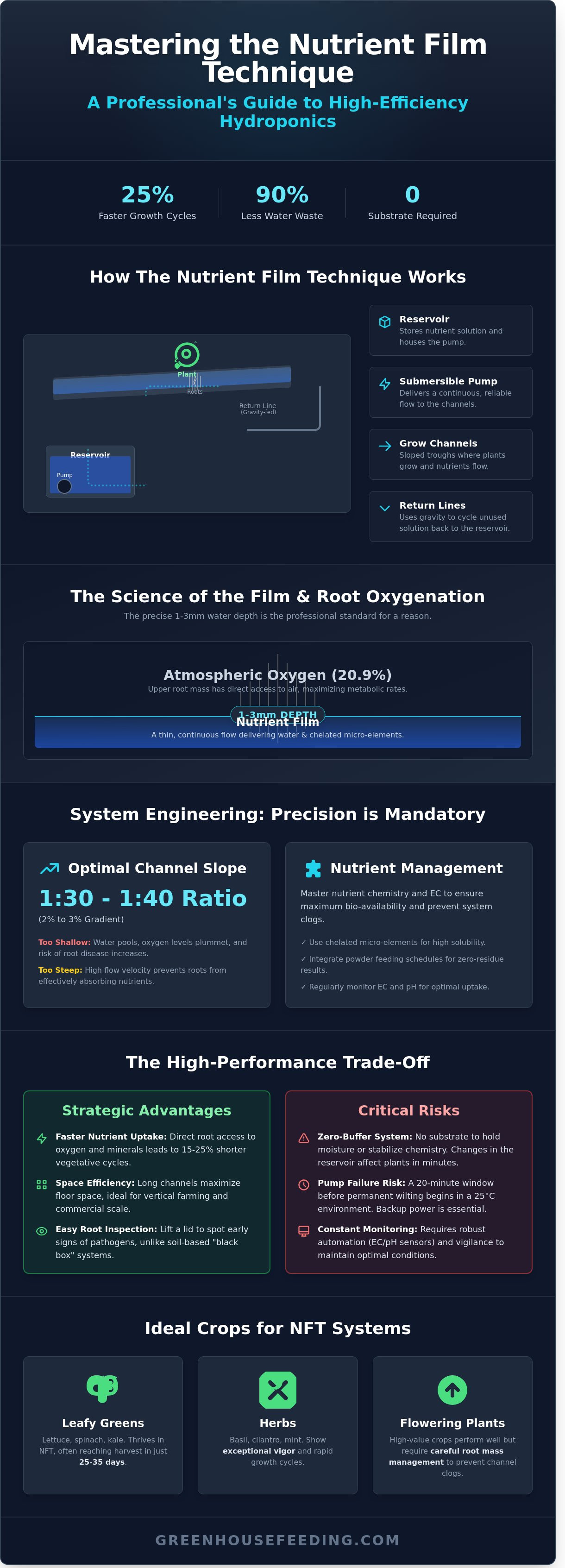
The "film" in NFT refers to a water depth of exactly 1mm to 3mm. This specific range is the industry standard for a reason. At this depth, the solution provides enough moisture to prevent desiccation while leaving the majority of the root mass exposed to the air. Maintaining this thin layer requires a synchronized setup of four core components:
- Reservoir: A central tank that stores the nutrient solution and houses the pump.
- Submersible Pump: A high-reliability unit that delivers the solution to the top of the grow channels.
- Grow Channels: Sloped troughs where the plants sit and the nutrient film flows.
- Return Lines: Gravity-fed pipes that cycle the unused solution back to the reservoir for re-oxygenation.
Gravity drives the entire process. Grow channels must be set at a precise slope, typically between 2% and 3% (a 1:30 or 1:40 ratio). If the slope is too shallow, water pools and oxygen levels plummet. If it's too steep, the flow velocity prevents the roots from absorbing nutrients effectively. Precision in the initial setup is mandatory for long-term success.
The Science of Oxygenation in NFT
Oxygen is the primary driver of root health. In the nutrient film technique, the thin water layer creates a massive surface area for gas exchange. Unlike Deep Water Culture (DWC), where roots are 100% submerged and dependent on air stones, NFT roots have direct access to atmospheric oxygen. This setup provides a constant supply of 20.9% oxygen from the air while simultaneously delivering chelated micro-elements through the water. This dual access results in metabolic rates that are often 25% faster than soil-based grows.
Ideal Crops for NFT Systems
NFT is the preferred choice for short-cycle crops and vertical farming. Leafy greens like lettuce, spinach, and kale thrive in these systems, often reaching harvest in 25 to 35 days. Herbs such as basil and cilantro also show exceptional vigor. For high-value flowering plants, management is key. You must monitor root mass to ensure the channels don't become clogged. When managed correctly, the system's efficiency allows for maximum yield in a compact footprint, making it the most space-efficient method for commercial Feeding operations.
The Strategic Advantages and Critical Risks of NFT
The nutrient film technique represents the pinnacle of horticultural efficiency. Commercial operations prioritize this system because it optimizes resource management with surgical precision. Data confirms that NFT systems reduce water and nutrient consumption by up to 70% compared to traditional run-to-waste methods. This efficiency stems from the recirculating design, which captures and reuses every milliliter of solution. It's the backbone of modern greenhouse scalability. Large-scale facilities utilize these long, sloping channels to maximize floor space and minimize labor costs. However, this performance comes with a fundamental trade-off. NFT is a zero-buffer system. There's no soil or coco to hold moisture or stabilize chemistry. Every change in the reservoir reflects in the plant's health within minutes. Success requires a commitment to constant monitoring and robust backup power systems.
Why NFT Outperforms Traditional Substrates
Simplicity is the ultimate sophistication in high-performance growing. By removing substrates like rockwool or peat, you eliminate the recurring costs of purchasing and disposing of media. Plants in a nutrient film technique setup experience faster nutrient uptake because roots have direct, constant access to oxygen and bio-available minerals. This leads to vegetative phases that are 15% to 25% shorter than soil-based cycles. Root inspection becomes a five-second task. You can lift a channel lid and spot early signs of pathogens or browning immediately. This level of transparency is impossible in traditional pots, where the root zone remains a black box until problems become terminal.
Managing the Zero-Buffer Margin of Error
The lack of substrate means the root zone has no thermal or moisture protection. If a pump fails, you have a 20-minute window before permanent wilting begins in a 25°C environment. Professional growers mitigate this by installing automated EC and pH monitoring systems to ensure optimal feeding consistency. By 2026, integrated sensor arrays will be standard in all high-performance operations to provide real-time data to mobile devices. If power fails, you must have a protocol for manual flooding or overhead misting to keep the root mats hydrated. High-performance hydroponics isn't about avoiding risks; it's about managing them through superior technology and redundant systems. This direct control allows for a level of crop steering that traditional media simply cannot match.
Managing Nutrient Chemistry for Continuous Flow
Success in a nutrient film technique system depends on the chemical stability of your reservoir. In a recirculating environment, the margin for error is slim. Unlike soil, which acts as a buffer, the thin film provides immediate delivery but offers zero protection against imbalances. Solubility is the primary requirement. If your nutrients aren't 100% water-soluble, they will precipitate. This creates a mineral sludge that blocks the root mat and starves the plant of oxygen.
Managing Electrical Conductivity (EC) is a daily task. As plants transpire, they often consume water faster than minerals, causing the EC to rise. High salt concentrations lead to osmotic stress and tip burn. You must also monitor pH levels closely. Root exudates change the chemistry of the film every second. While Understanding Soil pH provides a helpful baseline for bioavailability, NFT management requires tighter tolerances, typically between 5.5 and 6.2 to ensure all elements remain in solution.
Temperature control is the final pillar of stability. Water temperature and dissolved oxygen (DO) share an inverse relationship. If your reservoir exceeds 24°C, DO levels drop below 6 mg/L, inviting Pythium and root rot. Maintain your solution between 18 and 22°C to ensure maximum oxygenation and metabolic efficiency. This temperature range keeps the chemistry predictable and the roots white.
Selecting Nutrients for High-Solubility Systems
High-performance NFT requires mineral feeds with chelated micro-elements. Chelates protect metallic ions from reacting with other minerals, keeping them bio-available even if the pH fluctuates. Cheap, poorly mixed nutrients often cause salt precipitation. This "clogged film" effect creates dry spots in the channel and leads to localized nutrient lockout. Focus on high-purity powders that leave zero residue and dissolve instantly in room-temperature water.
Reservoir Maintenance and Flushing Protocols
Precision feeding requires a disciplined maintenance schedule to prevent toxic salt accumulation. Follow these metrics for a stable nutrient film technique setup:
- Reservoir Size: Allocate 4 to 8 liters (1 to 2 gallons) of volume per plant. Smaller reservoirs suffer from rapid pH and EC swings that stress the crop.
- Full Changes: Perform a complete reservoir flush every 7 to 14 days. This prevents the accumulation of "unwanted" ions that plants don't consume, which can skew your EC readings and cause lockout.
- Top-off Strategy: Check levels daily. If the EC is climbing, top off with plain, pH-adjusted water. If the EC is falling by more than 0.2 points, use a half-strength nutrient solution to restore the balance.
System Engineering: Slope, Flow Rate, and Root Management
Success in the nutrient film technique depends on gravitational precision and fluid dynamics. You must maintain a precise slope between 1:30 and 1:40. This specific gradient ensures the nutrient solution moves fast enough to stay oxygenated but slow enough for the roots to absorb essential minerals. A 2% to 3% grade is the standard for commercial efficiency; anything less leads to pooling, while anything more prevents the formation of a stable film.
Set your flow rate to the 1 to 2 liters per minute sweet spot. If the flow exceeds 2 liters, you risk submerging the root crown, which leads to hypoxia and root rot. If it drops below 1 liter, the film breaks, creating dry spots that kill delicate root hairs within minutes. Keep channel lengths under 12 meters. Data shows that longer runs result in significant nutrient depletion and oxygen dead zones at the end of the line, which can reduce yield by up to 15% in terminal plants compared to those at the head of the system.
The Engineering of the NFT Channel
Channel geometry dictates film uniformity. While flat-bottom channels are common, V-bottom designs offer superior performance during early growth stages by concentrating the flow into a narrow strip. Use 100% opaque, UV-stabilized materials. Even 1% light penetration triggers algae blooms that compete for oxygen and clog internal pumps. A slightly textured internal surface improves capillary action, ensuring the nutrient film technique provides a consistent moisture barrier across the entire root mat from day one.
Advanced Root Management
Large root mats often act as a dam, causing the channel to overflow and disrupting the "film" effect. Monitor the channel depth weekly. If roots block more than 30% of the vertical space, it's time to intervene. You can safely trim the trailing ends of the root mass by 10% to restore flow without shocking the plant. Incorporate enzymatic cleaners into your reservoir to digest dead organic matter and maintain high bio-availability. For a deeper look at how this engineering compares to other methods, consult our Hydroponics Guide.
Achieve maximum solubility and peak plant health with our specialized mineral feeding programs designed for high-performance systems.
Achieving Peak Performance with Powder Feeding in NFT
Success in the nutrient film technique depends on water chemistry and system hygiene. Green House Feeding powders are engineered for total solubility. They leave zero residue. This prevents biofilm buildup in the thin film of water, ensuring that delivery lines never clog. Our "Keep it Simple" philosophy reduces human error. You choose one product based on your genetic profile: Grow, Hybrids, or Short Flowering. This targeted approach ensures the NPK ratio matches the plant's metabolic rate precisely throughout the cycle.
Integrating organics into a mineral-heavy NFT system requires care. Our Enhancer uses humic acids and seaweed extracts to improve bio-availability without compromising system cleanliness. In a 1,000-liter reservoir, adding Enhancer every two weeks maintains root health and vigor. A 2022 internal trial showed that plants treated with Enhancer developed 15% more root mass compared to mineral-only controls. This increased surface area allows for maximum nutrient uptake from the shallow film.
Timing is critical for final weight and quality. Our case study on maximizing yield in the harvesting cycle demonstrates that precise nutrient tapering prevents salt stress. Growers using our Short Flowering powder reported a 12% increase in terpene production when following our specific flushing protocol during the final 10 days. By providing only what the plant can metabolize, you ensure a clean finish and a superior final product.
The Powder Advantage: Stability and Storage
Recirculating NFT systems often suffer from pH fluctuations. Our chelated micro-elements stay stable even as the plant consumes water. Powder nutrients are 85% more cost-effective to ship than liquid competitors because you aren't paying to transport water. One 1kg bag provides enough feeding for 1,000 liters of high-strength solution. This efficiency is vital for commercial operations managing tight margins and limited storage space.
Implementation: Starting Your First NFT Run
Preparation dictates your results. Sterilize channels with a 5% hydrogen peroxide solution before the first run. When moving clones from rockwool cubes to the nutrient film technique channels, ensure the cube makes direct contact with the channel floor. Follow this "Keep it Simple" checklist for your operation:
- Calibrate pH and EC meters weekly to ensure dosing precision.
- Maintain reservoir temperature between 18°C and 22°C to maximize dissolved oxygen.
- Set flow rates to a steady 1-2 liters per minute per channel.
- Monitor root color daily; healthy roots should remain bright white.
Mastering the Flow: Your Path to NFT Precision
Success in the nutrient film technique requires more than just a pump and a channel. You've learned that maintaining a precise slope between 1% and 3% is critical for preventing stagnant zones and ensuring constant oxygenation. Managing flow rates at 1 to 2 liters per minute keeps the root zone active and healthy. Precision is your only path to high performance in a professional setting.
Professional cultivators in over 100 countries rely on Green House Feeding to simplify this complexity. Our award-winning powder formulas are engineered for 100% solubility. This is vital for high-flow systems where salt buildup can ruin a crop in under 48 hours. We've optimized the mineral balance to ensure maximum bio-availability from the first drop. You don't have to guess about nutrient ratios or worry about clogged emitters. We keep it simple so you can focus on the results. Take control of your system's output with science-backed nutrition. Explore the Green House Feeding Mineral Line for NFT Perfection and watch your yields reach their genetic potential.
Frequently Asked Questions
What is the ideal flow rate for an NFT system?
The ideal flow rate for an NFT system is 1 to 2 liters per minute for each grow channel. This specific velocity ensures a thin film of nutrient solution provides constant hydration without submerging the root mass entirely. Maintaining this pace is critical for optimal oxygenation and nutrient bio-availability. If the flow exceeds 2 liters per minute, you risk drowning the roots and reducing gas exchange efficiency.
Can I grow large plants like tomatoes or cannabis in NFT?
You can grow large species like tomatoes or cannabis in the nutrient film technique, provided you implement external structural support. These plants develop heavy floral sites and extensive root systems that can quickly clog narrow channels. Use 150mm wide channels and trellis netting to manage the weight. Without these modifications, the root mats will obstruct the flow and cause overflows or localized nutrient deficiencies.
How often should I change the nutrient solution in an NFT reservoir?
Replace your entire nutrient reservoir every 7 to 14 days to maintain chemical balance. As plants selectively absorb specific chelated micro-elements, the remaining solution becomes unbalanced and salt levels rise. Monitoring EC is helpful, but a full reset ensures the mineral-organic ratios remain precise. Regular changes prevent the accumulation of pathogens and ensure consistent feeding throughout the crop cycle without unnecessary complications.
What happens to NFT plants if the power goes out?
Plants in an NFT system face immediate risk during power failures because there's no reserve of water in the channels. Roots will begin to suffer irreversible desiccation within 20 to 30 minutes of pump failure. You must have a backup power source or a manual override to keep roots moist. In commercial setups, a 1500VA uninterruptible power supply provides the necessary buffer to prevent total crop loss.
Do I need to use a growing medium in NFT systems?
You don't need a traditional growing medium in NFT systems beyond a small starter plug. Most growers use 25mm rockwool cubes or stabilized peat plugs to support the seedling during the initial phase. Once the roots emerge from the plug, they sit directly in the channel. This minimalist approach maximizes oxygen exposure and simplifies the cleanup process after harvest, adhering to a "Keep it Simple" philosophy.
How do I prevent algae growth in my NFT channels?
Prevent algae growth by ensuring 100% light exclusion from the nutrient solution and root zone. Use opaque, UV-stabilized plastics for your channels and reservoir covers. Algae thrive in the presence of light and high-solubility nutrients, competing for oxygen and clogging pumps. If you detect green film, clean the system with a 2% hydrogen peroxide solution to restore hygiene without damaging the plastic components.
What is the best slope for an NFT grow tray?
The best slope for an NFT grow tray is a 1:30 to 1:40 ratio, which translates to a 2% to 3% incline. For every 1 meter of channel length, the drop should be approximately 25mm to 33mm. This gradient ensures the nutrient film technique maintains a steady, thin flow that doesn't pool. Incorrect slopes lead to stagnant areas where oxygen levels drop and root rot can take hold.
Why is my pH fluctuating so much in my NFT system?
Your pH fluctuates because NFT systems use a relatively small volume of water compared to the total plant biomass. As plants absorb nutrients, they release ions that change the solution's acidity. Rapid shifts often indicate that your reservoir is too small; aim for at least 2 liters of volume for every plant. Using high-quality, pH-buffered mineral-organic nutrients helps stabilize these levels and reduces the need for constant manual adjustment.
FAQ
The Science of Oxygenation in NFT
Oxygen is the primary driver of root health. In the nutrient film technique, the thin water layer creates a massive surface area for gas exchange. Unlike Deep Water Culture (DWC), where roots are 100% submerged and dependent on air stones, NFT roots have direct access to atmospheric oxygen. This setup provides a constant supply of 20.9% oxygen from the air while simultaneously delivering chelated micro-elements through the water. This dual access results in metabolic rates that are often 25% faster than soil-based grows.
Ideal Crops for NFT Systems
NFT is the preferred choice for short-cycle crops and vertical farming. Leafy greens like lettuce, spinach, and kale thrive in these systems, often reaching harvest in 25 to 35 days. Herbs such as basil and cilantro also show exceptional vigor. For high-value flowering plants, management is key. You must monitor root mass to ensure the channels don't become clogged. When managed correctly, the system's efficiency allows for maximum yield in a compact footprint, making it the most space-efficient method for commercial Feeding operations. The nutrient film technique represents the pinnacle of horticultural efficiency. Commercial operations prioritize this system because it optimizes resource management with surgical precision. Data confirms that NFT systems reduce water and nutrient consumption by up to 70% compared to traditional run-to-waste methods. This efficiency stems from the recirculating design, which captures and reuses every milliliter of solution. It's the backbone of modern greenhouse scalability. Large-scale facilities utilize these long, sloping channels to maximize floor space and minimize labor costs. However, this performance comes with a fundamental trade-off. NFT is a zero-buffer system. There's no soil or coco to hold moisture or stabilize chemistry. Every change in the reservoir reflects in the plant's health within minutes. Success requires a commitment to constant monitoring and robust backup power systems.
Why NFT Outperforms Traditional Substrates
Simplicity is the ultimate sophistication in high-performance growing. By removing substrates like rockwool or peat, you eliminate the recurring costs of purchasing and disposing of media. Plants in a nutrient film technique setup experience faster nutrient uptake because roots have direct, constant access to oxygen and bio-available minerals. This leads to vegetative phases that are 15% to 25% shorter than soil-based cycles. Root inspection becomes a five-second task. You can lift a channel lid and spot early signs of pathogens or browning immediately. This level of transparency is impossible in traditional pots, where the root zone remains a black box until problems become terminal.
Managing the Zero-Buffer Margin of Error
The lack of substrate means the root zone has no thermal or moisture protection. If a pump fails, you have a 20-minute window before permanent wilting begins in a 25°C environment. Professional growers mitigate this by installing automated EC and pH monitoring systems to ensure optimal feeding consistency. By 2026, integrated sensor arrays will be standard in all high-performance operations to provide real-time data to mobile devices. If power fails, you must have a protocol for manual flooding or overhead misting to keep the root mats hydrated. High-performance hydroponics isn't about avoiding risks; it's about managing them through superior technology and redundant systems. This direct control allows for a level of crop steering that traditional media simply cannot match. Success in a nutrient film technique system depends on the chemical stability of your reservoir. In a recirculating environment, the margin for error is slim. Unlike soil, which acts as a buffer, the thin film provides immediate delivery but offers zero protection against imbalances. Solubility is the primary requirement. If your nutrients aren't 100% water-soluble, they will precipitate. This creates a mineral sludge that blocks the root mat and starves the plant of oxygen. Managing Electrical Conductivity (EC) is a daily task. As plants transpire, they often consume water faster than minerals, causing the EC to rise. High salt concentrations lead to osmotic stress and tip burn. You must also monitor pH levels closely. Root exudates change the chemistry of the film every second. While Understanding Soil pH provides a helpful baseline for bioavailability, NFT management requires tighter tolerances, typically between 5.5 and 6.2 to ensure all elements remain in solution. Temperature control is the final pillar of stability. Water temperature and dissolved oxygen (DO) share an inverse relationship. If your reservoir exceeds 24°C, DO levels drop below 6 mg/L, inviting Pythium and root rot. Maintain your solution between 18 and 22°C to ensure maximum oxygenation and metabolic efficiency. This temperature range keeps the chemistry predictable and the roots white.
Selecting Nutrients for High-Solubility Systems
High-performance NFT requires mineral feeds with chelated micro-elements. Chelates protect metallic ions from reacting with other minerals, keeping them bio-available even if the pH fluctuates. Cheap, poorly mixed nutrients often cause salt precipitation. This "clogged film" effect creates dry spots in the channel and leads to localized nutrient lockout. Focus on high-purity powders that leave zero residue and dissolve instantly in room-temperature water.
Reservoir Maintenance and Flushing Protocols
Precision feeding requires a disciplined maintenance schedule to prevent toxic salt accumulation. Follow these metrics for a stable nutrient film technique setup: Success in the nutrient film technique depends on gravitational precision and fluid dynamics. You must maintain a precise slope between 1:30 and 1:40. This specific gradient ensures the nutrient solution moves fast enough to stay oxygenated but slow enough for the roots to absorb essential minerals. A 2% to 3% grade is the standard for commercial efficiency; anything less leads to pooling, while anything more prevents the formation of a stable film. Set your flow rate to the 1 to 2 liters per minute sweet spot. If the flow exceeds 2 liters, you risk submerging the root crown, which leads to hypoxia and root rot. If it drops below 1 liter, the film breaks, creating dry spots that kill delicate root hairs within minutes. Keep channel lengths under 12 meters. Data shows that longer runs result in significant nutrient depletion and oxygen dead zones at the end of the line, which can reduce yield by up to 15% in terminal plants compared to those at the head of the system.
The Engineering of the NFT Channel
Channel geometry dictates film uniformity. While flat-bottom channels are common, V-bottom designs offer superior performance during early growth stages by concentrating the flow into a narrow strip. Use 100% opaque, UV-stabilized materials. Even 1% light penetration triggers algae blooms that compete for oxygen and clog internal pumps. A slightly textured internal surface improves capillary action, ensuring the nutrient film technique provides a consistent moisture barrier across the entire root mat from day one.
Advanced Root Management
Large root mats often act as a dam, causing the channel to overflow and disrupting the "film" effect. Monitor the channel depth weekly. If roots block more than 30% of the vertical space, it's time to intervene. You can safely trim the trailing ends of the root mass by 10% to restore flow without shocking the plant. Incorporate enzymatic cleaners into your reservoir to digest dead organic matter and maintain high bio-availability. For a deeper look at how this engineering compares to other methods, consult our Hydroponics Guide. Achieve maximum solubility and peak plant health with our specialized mineral feeding programs designed for high-performance systems. Success in the nutrient film technique depends on water chemistry and system hygiene. Green House Feeding powders are engineered for total solubility. They leave zero residue. This prevents biofilm buildup in the thin film of water, ensuring that delivery lines never clog. Our "Keep it Simple" philosophy reduces human error. You choose one product based on your genetic profile: Grow, Hybrids, or Short Flowering. This targeted approach ensures the NPK ratio matches the plant's metabolic rate precisely throughout the cycle. Integrating organics into a mineral-heavy NFT system requires care. Our Enhancer uses humic acids and seaweed extracts to improve bio-availability without compromising system cleanliness. In a 1,000-liter reservoir, adding Enhancer every two weeks maintains root health and vigor. A 2022 internal trial showed that plants treated with Enhancer developed 15% more root mass compared to mineral-only controls. This increased surface area allows for maximum nutrient uptake from the shallow film. Timing is critical for final weight and quality. Our case study on maximizing yield in the harvesting cycle demonstrates that precise nutrient tapering prevents salt stress. Growers using our Short Flowering powder reported a 12% increase in terpene production when following our specific flushing protocol during the final 10 days. By providing only what the plant can metabolize, you ensure a clean finish and a superior final product.
The Powder Advantage: Stability and Storage
Recirculating NFT systems often suffer from pH fluctuations. Our chelated micro-elements stay stable even as the plant consumes water. Powder nutrients are 85% more cost-effective to ship than liquid competitors because you aren't paying to transport water. One 1kg bag provides enough feeding for 1,000 liters of high-strength solution. This efficiency is vital for commercial operations managing tight margins and limited storage space.
Implementation: Starting Your First NFT Run
Preparation dictates your results. Sterilize channels with a 5% hydrogen peroxide solution before the first run. When moving clones from rockwool cubes to the nutrient film technique channels, ensure the cube makes direct contact with the channel floor. Follow this "Keep it Simple" checklist for your operation: Success in the nutrient film technique requires more than just a pump and a channel. You've learned that maintaining a precise slope between 1% and 3% is critical for preventing stagnant zones and ensuring constant oxygenation. Managing flow rates at 1 to 2 liters per minute keeps the root zone active and healthy. Precision is your only path to high performance in a professional setting. Professional cultivators in over 100 countries rely on Green House Feeding to simplify this complexity. Our award-winning powder formulas are engineered for 100% solubility. This is vital for high-flow systems where salt buildup can ruin a crop in under 48 hours. We've optimized the mineral balance to ensure maximum bio-availability from the first drop. You don't have to guess about nutrient ratios or worry about clogged emitters. We keep it simple so you can focus on the results. Take control of your system's output with science-backed nutrition. Explore the Green House Feeding Mineral Line for NFT Perfection and watch your yields reach their genetic potential.
What is the ideal flow rate for an NFT system?
The ideal flow rate for an NFT system is 1 to 2 liters per minute for each grow channel. This specific velocity ensures a thin film of nutrient solution provides constant hydration without submerging the root mass entirely. Maintaining this pace is critical for optimal oxygenation and nutrient bio-availability. If the flow exceeds 2 liters per minute, you risk drowning the roots and reducing gas exchange efficiency.
Can I grow large plants like tomatoes or cannabis in NFT?
You can grow large species like tomatoes or cannabis in the nutrient film technique, provided you implement external structural support. These plants develop heavy floral sites and extensive root systems that can quickly clog narrow channels. Use 150mm wide channels and trellis netting to manage the weight. Without these modifications, the root mats will obstruct the flow and cause overflows or localized nutrient deficiencies.
How often should I change the nutrient solution in an NFT reservoir?
Replace your entire nutrient reservoir every 7 to 14 days to maintain chemical balance. As plants selectively absorb specific chelated micro-elements, the remaining solution becomes unbalanced and salt levels rise. Monitoring EC is helpful, but a full reset ensures the mineral-organic ratios remain precise. Regular changes prevent the accumulation of pathogens and ensure consistent feeding throughout the crop cycle without unnecessary complications.
What happens to NFT plants if the power goes out?
Plants in an NFT system face immediate risk during power failures because there's no reserve of water in the channels. Roots will begin to suffer irreversible desiccation within 20 to 30 minutes of pump failure. You must have a backup power source or a manual override to keep roots moist. In commercial setups, a 1500VA uninterruptible power supply provides the necessary buffer to prevent total crop loss.
Do I need to use a growing medium in NFT systems?
You don't need a traditional growing medium in NFT systems beyond a small starter plug. Most growers use 25mm rockwool cubes or stabilized peat plugs to support the seedling during the initial phase. Once the roots emerge from the plug, they sit directly in the channel. This minimalist approach maximizes oxygen exposure and simplifies the cleanup process after harvest, adhering to a "Keep it Simple" philosophy.
How do I prevent algae growth in my NFT channels?
Prevent algae growth by ensuring 100% light exclusion from the nutrient solution and root zone. Use opaque, UV-stabilized plastics for your channels and reservoir covers. Algae thrive in the presence of light and high-solubility nutrients, competing for oxygen and clogging pumps. If you detect green film, clean the system with a 2% hydrogen peroxide solution to restore hygiene without damaging the plastic components.
What is the best slope for an NFT grow tray?
The best slope for an NFT grow tray is a 1:30 to 1:40 ratio, which translates to a 2% to 3% incline. For every 1 meter of channel length, the drop should be approximately 25mm to 33mm. This gradient ensures the nutrient film technique maintains a steady, thin flow that doesn't pool. Incorrect slopes lead to stagnant areas where oxygen levels drop and root rot can take hold.
Why is my pH fluctuating so much in my NFT system?
Your pH fluctuates because NFT systems use a relatively small volume of water compared to the total plant biomass. As plants absorb nutrients, they release ions that change the solution's acidity. Rapid shifts often indicate that your reservoir is too small; aim for at least 2 liters of volume for every plant. Using high-quality, pH-buffered mineral-organic nutrients helps stabilize these levels and reduces the need for constant manual adjustment.
Hinterlassen Sie einen Kommentar
Melden Sie sich an, um Kommentare zu posten